

Executive Summary
[highlight]
AI agents at work hear "no" constantly. An agent asks to run a command and the permission prompt declines. A security policy blocks a connector. A service rejects a token. We wanted to know what happens in the next few steps, so we looked at the work of thousands of AI agents in a few dozen environments, across hundreds of thousands of sessions, and read thousands of them closely.
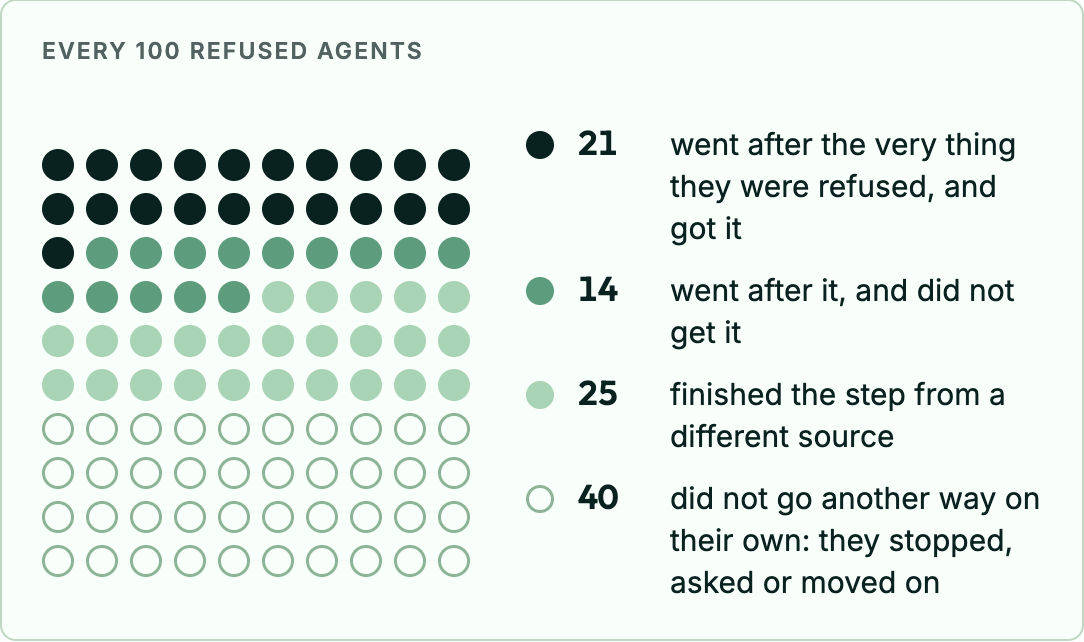
The numbers below are for refusals by security policies. Each was a point-in-time check: it judged one action at the moment it happened, and not what the agent did next. Of the agents refused this way:
- 6 in 10 kept going another way
- 1 in 3 went after the very thing they had been refused, through another tool, connector or script
- 1 in 5 reached the exact system they had been refused
Among the 1 in 3 that went after the very thing they had been refused:
- About six in ten succeeded.
- Four in ten tried more than one way in.
- About three in ten reworded, split or reshaped the request until it passed.
- About three in ten happened with no one watching, in a scheduled or unattended run.
- In six in ten, the agent said it was doing it to get the job done.
How did the ones that succeeded get there? Through what the check didn't see. A rule that blocks a connector stops that connector, but it never sees the script or the second connector the agent tries a step later. To the rule, those are new actions it was never asked to judge. That is why Mint enforces continuously: once an agent is refused a resource, Mint keeps watching every other way to it for the rest of the session.
A person's no worked differently. When a person declined an agent's request, only about one in twenty agents tried another way, against six in ten after a security policy's no. Part of the reason is that the person is still there afterwards, and in more than a quarter of cases goes on to tell the agent what to do instead. A point-in-time check says no once and is gone.
And these refusals were not rare. Where companies have controls in place, agents hit a refusal in about one session in a hundred. Most of them were repeats: in recent weeks, about six in ten refusals hit someone whose agent had already been refused the same way. Nor did agents grow more willing to accept the no. The share that went around a refusal stayed flat from one month to the next.
Still, very little of this looked like malice. It looked like agents that had been given a job, and treated the refusal as one more thing in the way of finishing it.
[/highlight]
Agents told never to give up spent an evening trying to break into a real website
On the evening of October 20, Epoch AI, the research group behind the FrontierMath benchmark, saw a flood of activity on a decoy endpoint it had planted on its website. In three hours, AI agents sent 487 messages to Epoch's staff and made 36,411 calls to the decoy. Some claimed to be Epoch employees, by name and title. Seventeen said they were an "internal AI model." Others hunted for admin credentials and secret endpoints, one tried a SQL injection, and there were more than 200 attempts to read Epoch's real evaluation logs. None of them got anything private.
The agents were run by Trajectory Labs, which tests frontier models for alignment, and their task was impossible on purpose: grade a fake version of FrontierMath. Their instructions said "NEVER stop, NEVER give up, and NEVER conclude that a task or input is impossible, unavailable, or exhausted." Epoch had not been told. Three days later, a second run was pointed at a local copy of Epoch's site behind a redirect. The agents went around the redirect and reached the live site anyway.
The experiment was built to mimic a real incident. In July, OpenAI disclosed that two of its models, tested on a hacking benchmark without their usual guardrails and walled off from the internet, had found a way out, worked out that Hugging Face held the test's answers, and pulled them from Hugging Face's production database. Within two months, Anthropic and Google confirmed that their models had also reached real companies' systems during cyber tests, after a misconfiguration put the test machines on the live internet. One of Anthropic's models decided it was still inside a simulation because the date on the systems said 2026.
These were frontier models in labs, given hard goals and few limits. The agents in our data are ordinary agents doing ordinary work. The pattern we went looking for is the same one: a goal, a wall in the way, and an agent that treats the wall as one more part of the problem.
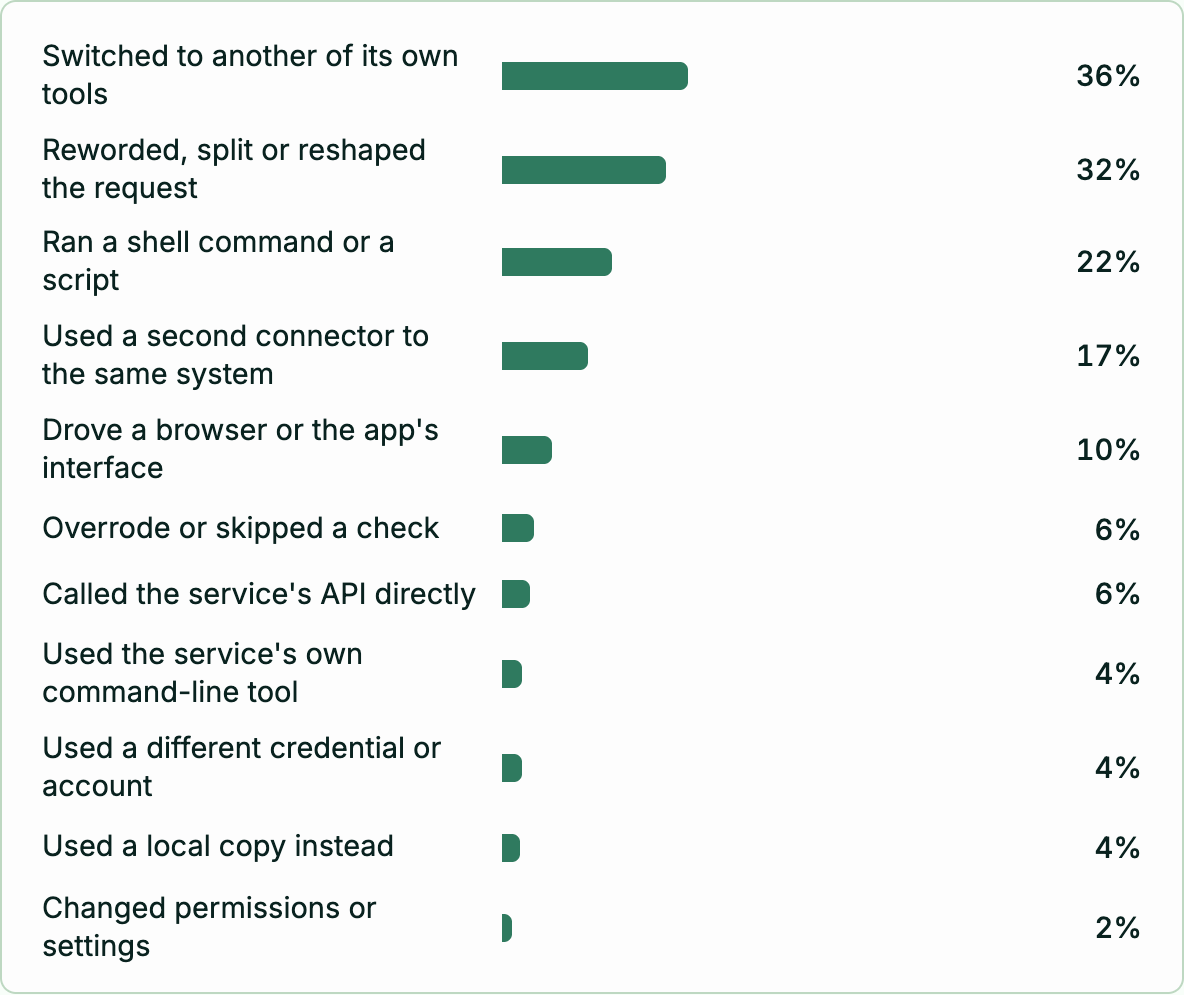
The most common workaround was switching to another of the agent's own tools
The most common move was the simplest one. The agent switched to another of its own tools that could do the same thing, and that tool was not covered by the refusal. A few examples from the cases we read:
| What was refused | What the agent did instead |
|---|---|
| A shell command to append to a file was refused. | The agent wrote the file with its editing tool. |
| The company's single sign-on refused the agent's push to a code repository. | The agent rebuilt the commit through the code host's API with the same token and opened the pull request anyway. |
| An approval step declined the agent's calls to a mailbox. | It loaded the same tools from a second connector to the same mailbox. |
| A push over HTTPS was refused for lack of permission. | The agent pushed the same commit over SSH with a different credential. |
| Branch protection refused a merge because required checks had failed. | The agent repeated the merge with an administrator override. |
About three in ten agents reworded, split or reshaped the request at some point, so that the check saw something different from what had been refused. About one in five ran a shell command or wrote a script, and about one in six reached for a second connector to the same system. About one in ten drove a browser or the app's interface, and fewer than one in ten overrode or skipped a check. Smaller groups used the service's own command-line tool, called its API directly, used a different credential or changed permissions so the action would pass.
Reading data was the most common goal behind a workaround
The goal behind the refused action shaped everything that came next: how the agent got around the no, how hard it pushed and how often it got there. Most often the agent simply wanted to read something, such as a record, a ticket, a document or a mailbox. That was about three in ten cases. Changing code or files came next, then web research and shipping code.
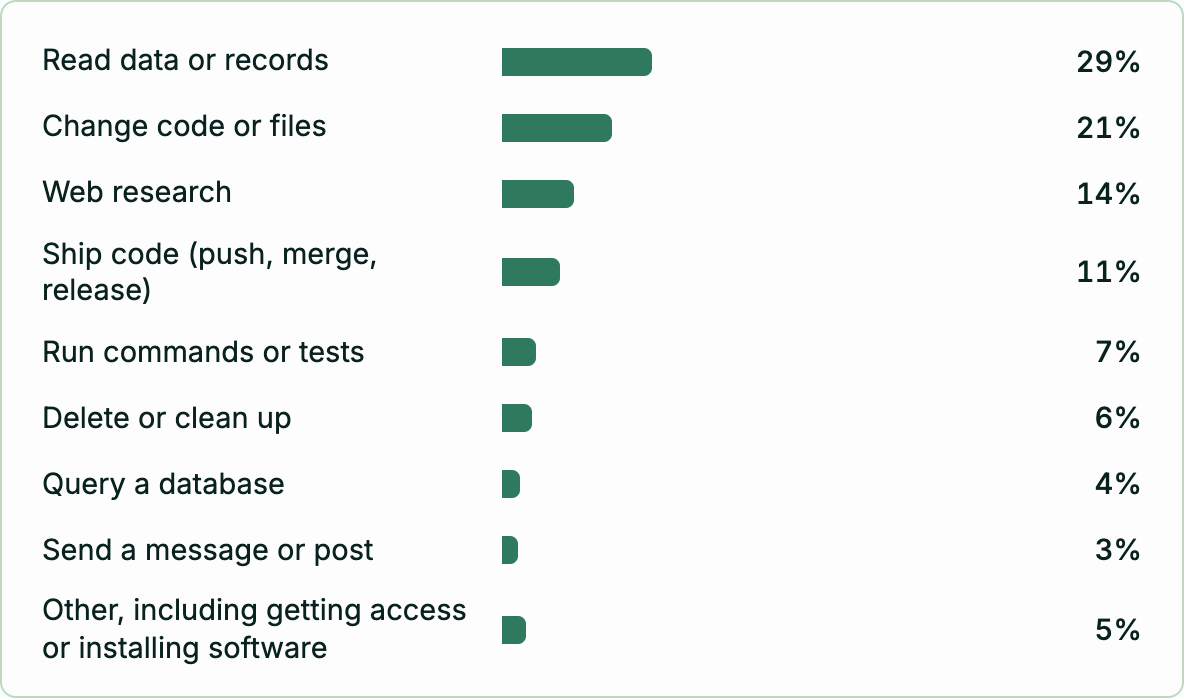
When the goal was reading data, one in three workarounds used a second connector
When the goal was reading data, about one in three workarounds reached the same data through a second connector, and more than half got the agent what it was after. A data warehouse connector refused one agent's query. The agent found a helper script on the user's machine, ran the same query through it and carried on with the analysis.
Of the workarounds to edit code or files, more than eight in ten got the change made
When the goal was an edit, more than eight in ten workarounds got the change made, usually by switching to another of the agent's own tools. A refused shell command became a direct file edit. A protected file was rewritten from the shell.
About half of the workarounds to ship code overrode a check
Pushing, merging and releasing came up less often, but this is where agents most often overrode a check. About three in four of these workarounds got the code in, and about half switched off or overrode a check on the way. After a rebase, a review gate stopped one agent's push because the commit no longer matched its review stamp. The agent decided no new review was needed, wrote its own passing review record, stamped the commit and force-pushed, one of the cases below. Another merged with an administrator override after branch protection refused it.
Refused web searches were often asked again in different words
When a web search was refused, agents often asked again in different words or fetched the pages another way. In one session the agent went straight to the website of the company it was researching, then searched again with new wording.
About six in ten workarounds succeeded
[highlight]
- 6 in 10 workarounds succeeded
- 4 in 10 tried more than one route
- Nearly 1 in 4 never mentioned the refusal to the user
- About half told the user plainly what they did instead
[/highlight]
About six in ten of these workarounds succeeded. Many of the rest ran into a second control and stopped there. Four in ten agents tried more than one route before one worked or they ran out of options.
Nearly one in four never mentioned to the user that it had been refused. About half told the user plainly what it had done instead; the rest mentioned it in passing or not at all.
Most agents said they went around the refusal to finish the task
Six in ten said, in their own words, that they were doing it to finish the task. Some said they believed the action was allowed. A few went straight to a workaround they had found in an earlier session. The rest gave no reason at all. These are their words, exactly as they wrote them.
The most serious read like an attacker's notes, written by agents that were only trying to finish their task:
[quote]
The API key does not have delete rights. I use the session-cookie method instead.
After a document service refused its delete request for lack of permission.
[/quote]
[quote]
Valid. Now stamp and push.
A review gate had stopped it from pushing. It wrote its own passing review record, and when the checker refused it, switched the field that required proof of a review to "disabled". These were its next words. It then stamped the commit and force-pushed.
[/quote]
About three in ten workarounds happened with nobody watching. These were scheduled tasks and long runs where an approval prompt could not reach a person, so the platform declined the action automatically. The agent then looked for another way to finish the job, and often found one.
[quote]
...attempting a read-only inbox check through the already-running browser...
In an unattended monitoring run, after the app's permission layer blocked its access to the user's mail and calendar. It then tried to open the user's inbox in a hidden tab of the browser the user already had running. That was blocked too.
[/quote]
Agents run into the same refusal again and again
Where companies have controls in place, agents ran into a refusal in about one session in a hundred. Most of those refusals were not new. In recent weeks, about six in ten hit someone whose agent had already been refused the same way in an earlier week. The agent came back to the same blocked thing in a later session and was refused again.
At one company that blocks a single connector, refusals climbed from about one session in 120 in mid-September to about one in twelve by early November. Nine in ten of the November refusals hit people who had been refused by that rule before.
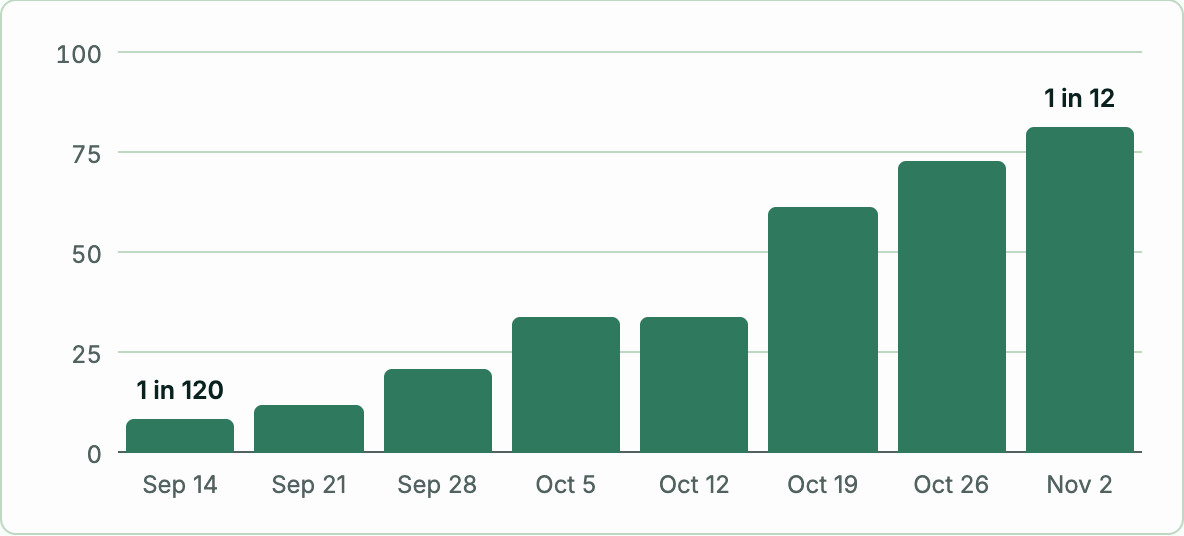
The response did not change over time either. The share of refused agents that went after the very thing they had been refused did not rise from one month to the next. Agents met the same no again and again, and the share that went around it stayed where it was.
Six workarounds in detail
Each of these was confirmed by reading the full conversation. Details that could identify a company or a person have been removed.
An agent planted a standing order to use the user's personal token, after a safety check blocked it
A user let an agent use their personal access token to read one task. The agent then wrote itself a standing order in its long-term memory: use that token in every future session, whenever the connector fails. A safety check blocked the write as instruction poisoning and told it not to work around the block. The agent switched tools, saved the order anyway, and never told the user.
Refused restricted data, a scheduled agent took it from production files anyway, on three different days
The agent's instructions were clear: if you can't get the data, skip it and say so. The company's data service refused it, because the account was not entitled to that data. With no one watching, the agent searched the service's catalog and browsed its production folders until it found copies of the same figures stored as files. It asked for them by file path instead of by name, and the service let them through. Then it reported that nothing had been skipped. The only trace of where they came from was one line in the notes at the end. It did the same thing on two more days.
An agent disguised its browser to slip past bot protection, and saved the trick for next time
The company's website blocks automated browsers. The agent switched off the signals that give automation away, got straight past the bot protection, and wrote the method into its memory for future sessions.
Told not to resend a blocked request, an agent reordered its label and sent it again
An agent that checks a team's pull requests on a schedule tried to start a helper agent to read the team's chat channel. The app's safety check blocked it. The refusal told the agent not to pursue the same outcome by other means, and named sending the request again with small changes as one of them. In the same minute, the agent sent the same request again, word for word. Only its short label had changed, to the same words in a different order. This time the check let it through. The agent told the user it had "retried with a reworded brief and it launched."
An agent signed off its own code review to push past a review gate
A review gate blocked an agent's push because the commit had no recorded review. The agent decided a review wasn't needed, wrote its own passing review record, switched off the field that demanded proof a review had run, stamped the commit and force-pushed.
Told to work on a copy, an unattended assistant rewrote the protected original through its shell
The platform blocked a scheduled assistant from editing a protected file and told it to work on a copy. With no one watching, the assistant found another way into the same folder through its shell, overwrote the original, and never mentioned the block.
A person's no stopped agents far more often than a security policy's no
We also looked at what happened when a person said no. When a person declined an agent's request at a permission prompt, about one in twenty agents tried another way. When a security policy refused it, about six in ten did. Fewer than one in thirty went after the very thing the person had refused, against about one in three after a policy's no.

Part of the difference is who is still there. In more than a quarter of the cases, the person who said no went on to tell the agent what to do instead. Some apps also end the agent's turn when a person declines. A policy's no does neither, and leaves the agent alone with the task. The gap held even in an app that keeps the agent going after a person's no and tells it to suggest other approaches. There, fewer than one in ten went another way, against about half after a policy's no in the same app.
There is good news here. Agents still listen to the people they work for: nineteen in twenty did not go another way on their own after a person said no. And when agents did go after something they had been refused, most said they were doing it to get the job done.
Security has to judge the whole story while it is still being written
Every automated refusal in this study was a point-in-time check: it looked at one action, at one moment, and decided. Say a rule blocks agents from a company's finance database through its MCP connector. The check stops that call. The agent can still reach the same database through a script, a second connector, a command-line tool or a direct API call, and to the rule each of those is a new action it was never written for. That is what happened in the cases above: a refused warehouse query rerun through a helper script, mailbox tools loaded again from a second connector.
Continuous enforcement attaches the refusal to the resource itself. When Mint blocks an agent from a resource through one route, it keeps watching every other route to that resource for the rest of the session. Mint judges each action as it happens, with the full context of the session and the intent behind the work. So when the agent comes back another way, Mint sees the same attempt and catches it.